


- Aaroh-Avroh
- Aaroh of a Raag is the sequence of notes in ascending order between Madhya Shadja (S) and Tar Shadja (S’). Avroh is the sequence in descending order between Tar Shadja (S’) and Madhya Shadja (S).
- Alankar
- Alankars, literally “jewels,” are ornamental combinations of the notes of a Raag. They follow specific patterns and are especially effective while rendering Taans.
- Alap
- Alap is the improvisational development of a Raag, where the artist explores its structure while observing all the Raag's rules.
- Antara
- Antara is the second stanza of a composition, usually emphasizing the upper notes of the Raag.
- Avirbhav-Tirobhav
- Avirbhav means making the original form of the Raag visible, while Tirobhav refers to deviating from the original form by hinting at a nearby Raag.
- Bada Khayal
- The first, slow-tempo composition of a Khayal performance.
- Bandish
- A composed piece in Hindustani classical music, typically with two parts corresponding to the Sthayi and Antara.
- Brij Bhasha
- A dialect of Hindi spoken in the Brij region, where Lord Krishna spent his childhood, and a prominent language for many Hindustani compositions.
- Chaturang
- "Chatur" means four and "anga" means parts. A chaturang comprises four elements: Khayal, Tarana, Sargam, and Tirvata.
- Chota Khayal
- A medium to fast-tempo composition that typically follows the Bada Khayal.
- Gamak
- Gamak refers to the embellishment (vibratory rendering with Meend) of swaras. It can be heavy or light, adding expressive ornamentation.
- Gharana
- A musical lineage or tradition representing a particular style of singing, usually passed down within a family.
- Jati
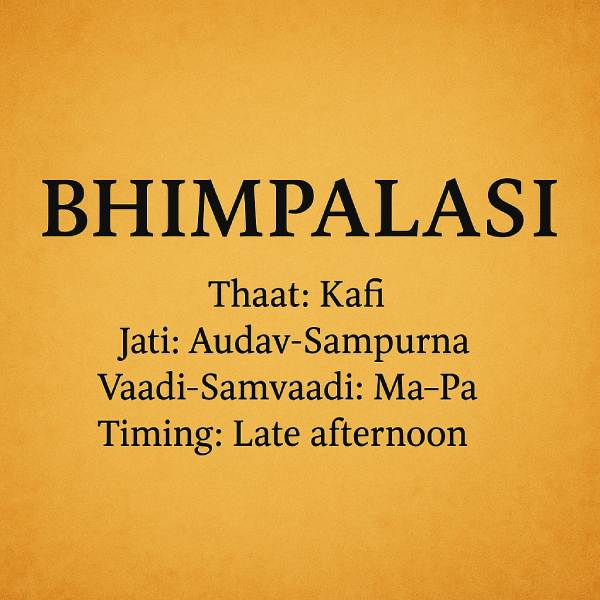
- The classification of a Raag based on the number of notes used in its Aaroh and Avroh. Examples include Sampurna (7 notes), Shadhav (6 notes), Audhav (5 notes), and Surtar (4 notes). (Often rendered with Vakra forms when notes are used in a non-linear sequence.)
- Jugalbandi
- A duet performance in which two artists perform together.
- Khatka
- If several notes are rendered in one continuous stroke, it is called a Khatka.
- Komal Swar
- A soft or flat note.
- Matra
- The basic counting unit of a Taal (rhythmic cycle).
- Meend
- A smooth, continuous gliding from one note to another, delivering the authentic flavor of Hindustani classical music.
- Mukhya-Ang or Pakad
- The essential note phrases that define a Raag; without these, the Raag cannot manifest itself.
- Murki
- A tonal embellishment where a note is rendered with a rapid, rounded approach (deriving simultaneously from both an upper and lower note).
- Naad
- The musical or cosmic sound.
- Poorvang-Uttarang
- Poorvang refers to the lower half of the octave (S, R, G, M) and Uttarang to the upper half (P, D, N, S’).
- Raag or Raaga
- A melodic framework defined by a specific sequence of ascending and descending notes, which creates an overall mood or emotion.
- Ras or Bhaav
- The emotional essence of a Raag. There are nine Ras in Hindustani music: Bhakti, Karuna, Veer, Veebhatsa, Vichitra, Hasya, Virah, Vairagya, and Krodh.
- Sargam
- A composition that uses the names of the notes (Sa, Re, Ga, Ma, Pa, Dha, Ni) instead of words.
- Sum
- The first and most important beat of a Taal, where rhythmic tension is released.
- Swar or Note
- A musical note. In Hindustani classical music, the seven basic (shuddha) swaras are Sa, Re, Ga, Ma, Pa, Dha, Ni. Re, Ga, Dha, and Ni have Komal (flat) forms, while Ma has a Teevra (sharp) form. Shadja (Sa) and Pancham (Pa) remain unaltered.
- Taal
- The cyclic rhythmic pattern on which a musical composition is structured (e.g., Teen Taal).
- Taan
- A rapid sequence of notes rendered in quick succession, often used during improvisation. Taans may incorporate patterns like Sapaat Taans, Alankars, and Gamak.
- Tabla
- The primary percussion instrument in Hindustani classical music, comprising a pair of tuned drums.
- Tanpura
- A drone instrument that provides a harmonic background for the performance.
- Tarana
- A composition that uses meaningless syllables (e.g., “ta na na na dere na”) instead of words.
- Thaat
- A system for classifying Raagas in Hindustani classical music. Modern Thaats (developed by Pt. Vishnu Narayan Bhatkhande) include Bilawal, Kalyan, Khamaj, Bhairav, Poorvi, Marwa, Kafi, Asavari, Bhairavi, and Todi.
- Thumri
- A popular light-classical genre in Hindustani music.
- Time of Raag
- The specific time period during which a Raag is traditionally rendered. The day is divided into four 3-hour Prahars (and the night as well), and certain Raagas are associated with specific times or seasons.
- Vadi-Samvadi
- Vadi is the most dominant note in a Raag (the “king” note), while Samvadi is the second most important note. Together, they define the unique character and mood of the Raag.
- Varjya-Swaras or Forbidden Notes
- Notes that are deliberately omitted in a Raag.
- Vilambit
- A slow tempo rendering, often used in the performance of Bada Khayal.
- Vishranti Sthan
- The resting or resolution note(s) where an alaap or taan typically ends (commonly Shadja/Sa, but sometimes other notes as well).

35+ Rare Hindustani Ragas 🎵 – Discover Seasonal & Hidden Gems of Indian Classical Music
🎼 Introduction Dive into the mesmerizing world of Indian classical music through a curated selection of unique ragas....

0 Comments